What is a temporary email address?
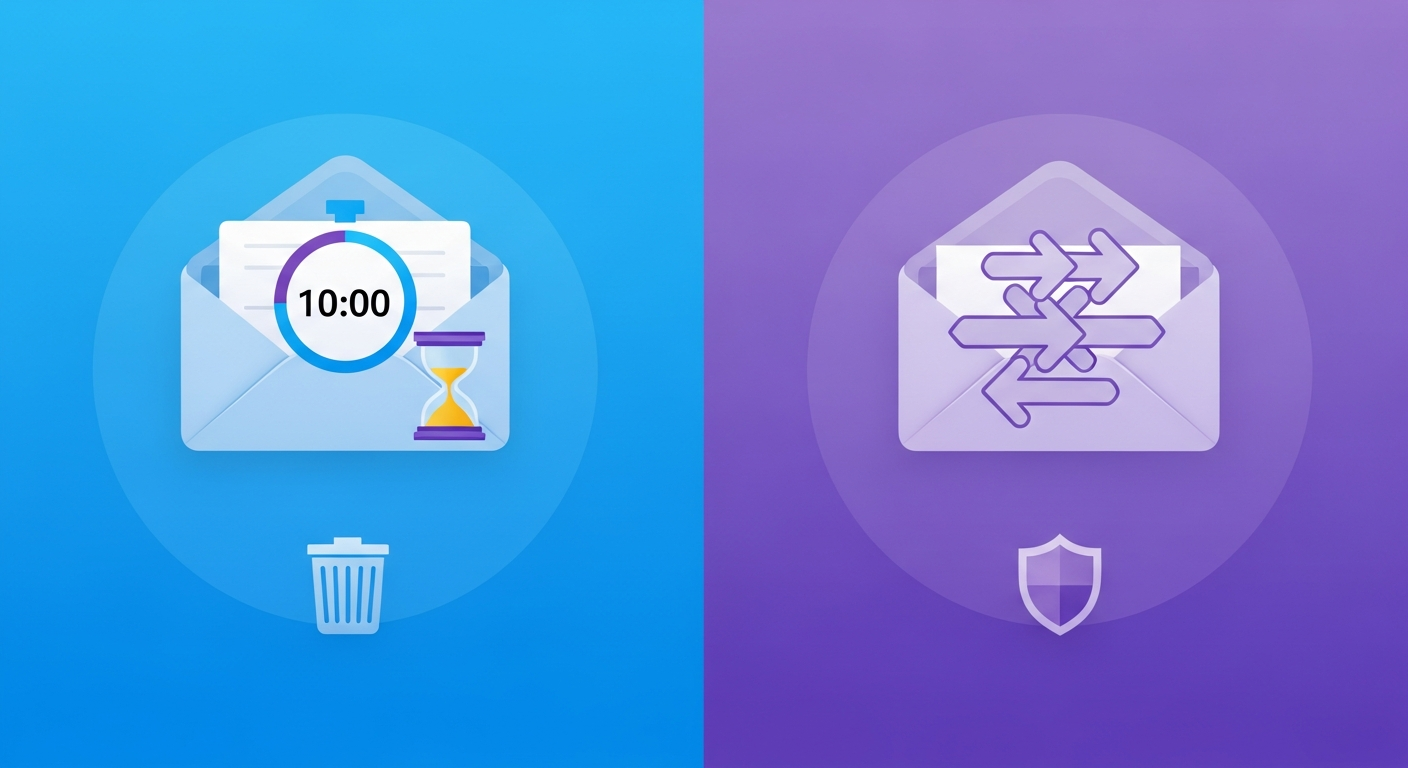
A temporary email address — also called disposable email, throwaway email, or burner email — is a real, fully working email inbox that you can use once and then discard. Unlike a permanent address such as gmail.com or outlook.com, a temporary address has a built-in expiry timer. When the timer runs out, the address stops receiving mail and every message ever delivered to it is permanently deleted from the server.
The key difference from your real inbox is that nothing links the temporary address to you personally. There is no name attached to it, no phone number, no date of birth — just a randomly generated string before the @ sign and a domain managed by the service. You never signed up with any personal details, which means the address cannot be traced back to you even if the service were breached.
Temporary email addresses look and function exactly like real email addresses. They have the same format (name@domain.com), they receive messages via the standard SMTP protocol, and the emails that arrive in them contain the same headers, attachments, and links as any other email. The only difference is the lifespan and the lack of a permanent identity attached to them.
Why do millions of people use disposable email every day?
The modern web runs on email gates. Nearly every website — from a news article to a PDF download to a SaaS free trial — requires an email address before it lets you in. The problem is that handing over your real address has a compounding cost over time.
The moment you enter your real email on a website, it enters that company's database. From there, several things can happen: the company sends you marketing emails you never asked for, the database is sold to third-party advertisers, or the company experiences a data breach and your address ends up in a list sold on the dark web. Each of these outcomes happens far more often than most people realise.
According to breach-tracking services, over 10 billion email records have been exposed in publicly known data breaches. If you have had the same email address for more than five years, there is a high probability it appears in at least one of those lists. The consequences range from annoying — your inbox fills with spam — to genuinely harmful, as attackers use known email addresses to target phishing campaigns.
Temporary email solves this by giving you a working inbox for the duration you need — typically the 30 seconds it takes to receive a verification code — and then making the address and all its messages vanish completely. There is no trail to follow, no address to sell, and no inbox to spam.
How does temporary email work technically?
A service like My Temp Mail operates a real mail server with real DNS MX records pointing to it for several owned domains. When you click Generate, the service creates a new entry in its database associating a randomly generated local part (the bit before the @) with one of those domains. From that moment, the mail server is configured to accept incoming SMTP connections delivering to that address.
Any website can send email to your temporary address. The email travels through the internet via standard SMTP — exactly as it would travel to a Gmail or Outlook address. When it arrives at My Temp Mail's server, it is stored in a short-lived database record tied to your inbox session.
Your browser receives the email in real time using Server-Sent Events (SSE), a technology that maintains a persistent connection between your browser and the server so that new messages appear in your inbox within seconds of arriving — without you needing to refresh the page.
When the address expires, a scheduled cleanup job runs. It removes the address from the mail server's accepted-recipients list (so future emails bounce rather than being delivered to nobody), deletes every message from the database, and removes all associated metadata. Nothing is archived. Nothing is moved to cold storage. The data is gone.
Who uses temporary email?
The range of people who use disposable email every day is broader than most people expect:
- Privacy-conscious individuals who want to read a news article, download a template, or try a tool without permanently attaching themselves to that company's marketing list.
- Software developers and QA engineers who need to test that their applications send emails correctly. Rather than using a real inbox and cluttering it with test messages, they generate a disposable address, trigger the email flow, verify the email arrived correctly, and discard the inbox.
- Gamers who create secondary accounts on gaming platforms, often to try content without affecting their main account.
- Researchers and journalists who need to sign up for services or access gated content without identifying themselves.
- Business users who sign up for free trials of competing software to evaluate it, without giving competitors their real business email.
- General internet users in countries with high rates of spam and email harvesting, where handing a real address to an unfamiliar website carries a significant risk of becoming overwhelmed with junk mail.
Estimates suggest hundreds of millions of temporary email addresses are generated every month globally. It is no longer a niche privacy practice — it is becoming standard behaviour for anyone who pays attention to what happens to their data.
Is temporary email legal?
Yes. Using a disposable email address is completely legal in virtually every country. It is simply a privacy tool — legally and conceptually no different from using a PO box instead of your home address for physical mail, or using a pseudonym when posting publicly online.
The temporary email service itself is legal because it operates a genuine mail server and delivers real email. There is nothing deceptive about the technology. The emails that websites send to temporary addresses are delivered and received — the service is not intercepting, forging, or blocking email.
Some websites prohibit the use of disposable email addresses in their terms of service. Violating a website's terms of service is a civil matter between you and that website — it is not illegal. In practice, enforcement is impossible: a website can reject known disposable domains, but it cannot compel you to use a permanent address.
What can you use temporary email for?
Temporary email works well in any situation where the interaction is genuinely one-time and you do not need long-term access to the account. Common and legitimate uses include:
- Receiving email verification links when signing up for services you want to try once
- Getting OTP (one-time password) codes sent by websites during login or account creation
- Downloading gated content — eBooks, templates, research reports — that require an email registration
- Signing up for free trials without starting a marketing email relationship
- Testing email delivery in software development and QA workflows
- Bypassing paywalls that require an email address for article access
- Registering for events, webinars, or Wi-Fi hotspots that demand an email address
When should you NOT use temporary email?
Temporary email is the wrong tool for situations where you need long-term, reliable access to an account. The most important cases to avoid:
- Bank accounts and financial services — these require ongoing communication for statements, fraud alerts, and security notifications. Losing access to the email means losing the ability to recover the account.
- Government services — tax filings, benefits, identity verification, and legal correspondence all require a permanently accessible inbox.
- Main work email or professional services — your employment, professional certifications, and business accounts need a recoverable email address.
- Any account where password recovery matters — if you ever need to reset your password, the reset link goes to the registered email. If that address has expired, the link goes nowhere and you are permanently locked out.
- Healthcare portals and medical services — appointments, prescriptions, and test results require reliable long-term access.
The simple rule: if you will ever need to access the account again or rely on it for anything important, use your real email address. If you are genuinely just getting something once and walking away, a temporary address is the smarter choice.
How is My Temp Mail different from other disposable email services?
My Temp Mail operates across multiple owned domains, which matters because many websites maintain blocklists of known disposable email providers. When one domain is added to a blocklist, you can switch to another from the dropdown — the address changes but the inbox behaviour remains identical. The service also delivers email in real time via SSE rather than requiring manual page refreshes, making it fast enough for time-sensitive OTP codes.
Unlike some disposable services, My Temp Mail deletes all data permanently when an address expires. There is no server-side history, no admin panel with a copy of old inboxes, and no backup that could be subpoenaed or breached to reveal past messages. What is gone is genuinely gone.